

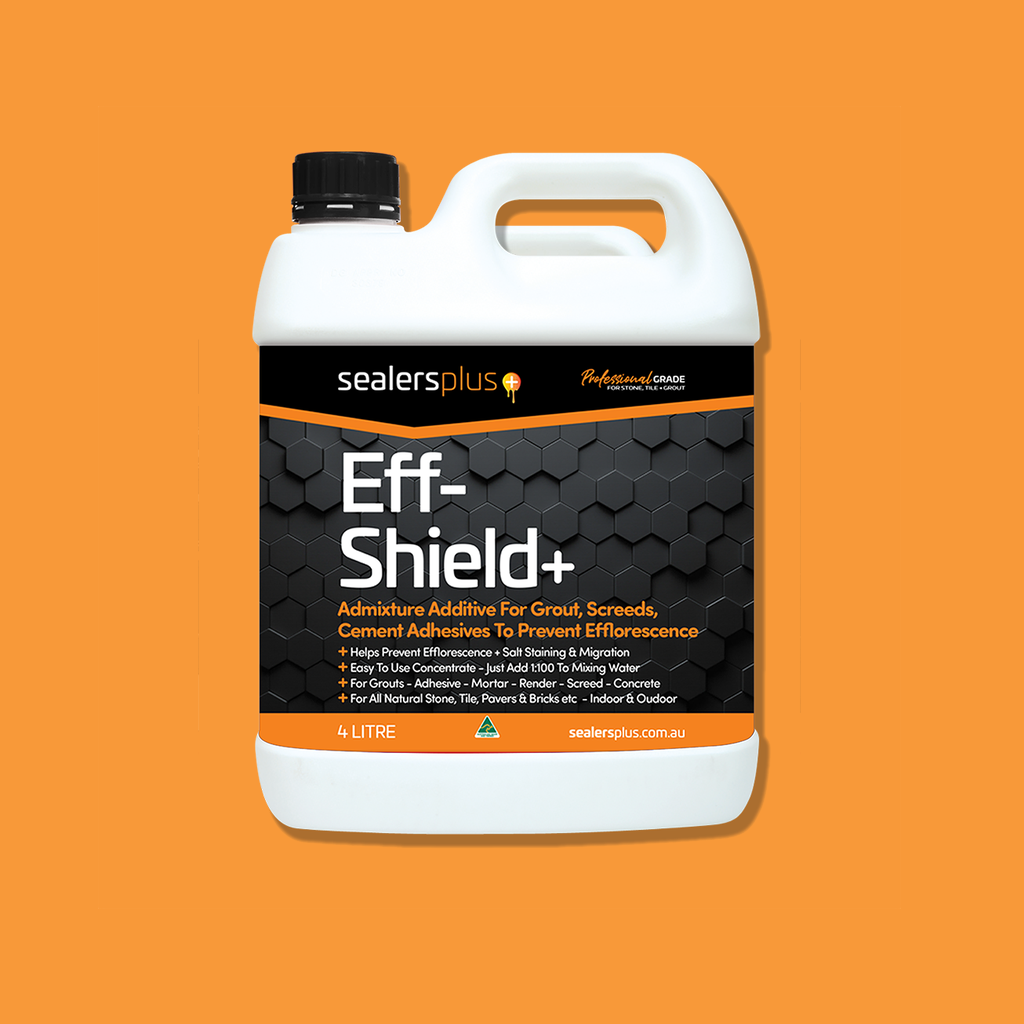
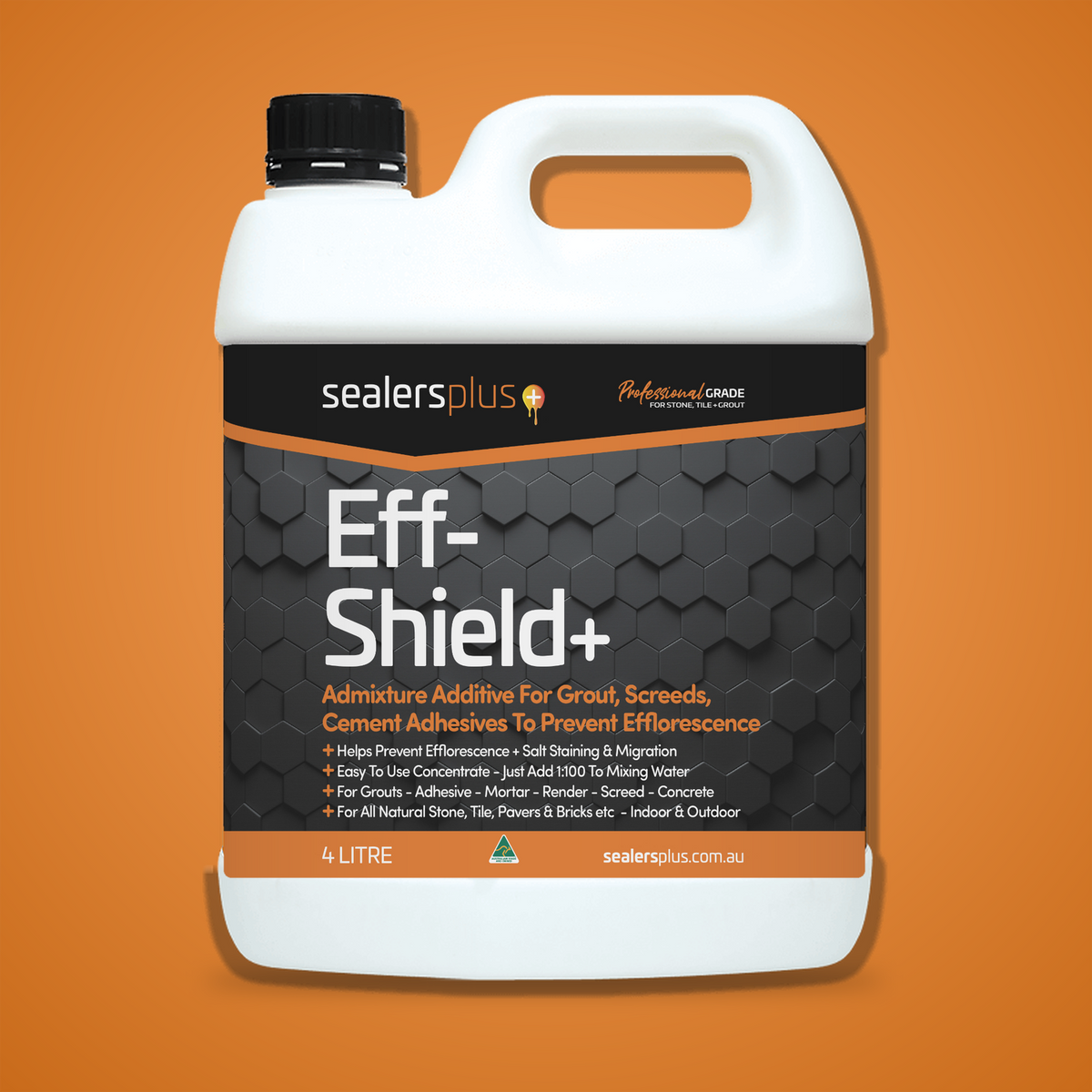

EFF-SHIELD+ Additive For Grout, Concrete, Adhesive and Screed For Efflorescence Control
FREE standard delivery over $50 (express extra)
Black Friday Week · Ends Tue 1 Dec
The 10% off is already in the price shown. Spend $300 or more and it becomes 15% off. Spend $500 or more and it becomes 20% off. The extra comes off automatically at checkout.*
Product details
- Water-Repellent Admixture for Grout, Screed & Mortar
- Helps Reduce Efflorescence From Within the Mix
- For Grout, Screed, Mortar & Cement-Based Adhesives
- Professional Grade – High Performance – Made in Australia
*Enhance'N'Seal (all sizes) and all 15 L and 20 L sizes are 10% off only and do not count toward the $300 or $500. Not available with other discounts or codes.
Couldn't load pickup availability
Pickup available at KURNELL
Usually ready in 24 hoursProfessional Grade · Sealers Plus (an Aqua-Seal brand)
Fast dispatch from Kurnell, NSW
Not sure? Call +61 2 9521-4000
Prefer to buy in store? Find a stockist
EFF-SHIELD+ - Additive For Grout, Concrete, Adhesive and Screed For Efflorescence Control
Full description
About EFF-SHIELD+
Professional Grade, breathable, water-repellent admixture for cement-based screeds, grouts, tile adhesives, mortars, renders, concrete and precast. Step 1 of the Eff-Control+ system.
Technical Bulletin (PDF) ›Description
Eff-Shield+ is a water-based, Professional Grade, highly concentrated hydrophobic (water-repellent) admixture made with advanced silicone technology. Added to the mixing water of screeds, grouts, cement-based tile adhesives, mortars, renders and concrete, it helps reduce water absorption and with it the efflorescence, picture framing and moisture staining that water carries to the surface. Breathable, No VOC and easy to use.
What does it do
As the mix cures, Eff-Shield+ lines the tiny capillary pores of the cement with a water-repellent layer, right through the full thickness of the screed, grout or mortar. The pores are lined, not blocked, so the material still breathes and can dry out.
- Helps reduce water absorption and capillary moisture movement
- Helps reduce the risk of primary (during curing) and secondary (later) efflorescence, by limiting the water that carries salts to the surface
- Helps reduce picture framing and edge darkening around tiles, stone and pavers
- Locked into the cement: it can't be washed out and isn't lost through surface wear
- No oily residue or surface film. Water repellency develops from about 24 hours
What it doesn't do
It is not a waterproofing membrane or damp-proof course and will not hold back water under pressure. It does not replace correct substrate preparation, falls, drainage, waterproofing, expansion joints or site testing, and does not give oil or grease stain resistance. It does not remove existing efflorescence: use OxiTreat+ or Oxi Gel+.
Where to use
Walls and floors in domestic, commercial and industrial, indoor and outdoor areas.
Add to
- Cement-based grouts
- Cement-based tile adhesives
- Tile & stone screeds
- Bedding mortars
- Brick, block & stone laying mortar
- Renders & toppings
- Concrete slabs, paths & driveways
- Precast pavers, blocks & bricks
Ideal for
- Bathrooms & wet areas
- Balconies & terraces
- Patios & courtyards
- Stairs & landings
- Pool surrounds & copings
- External paving
- Brick & block walls
- Domestic & commercial
How much to use
METHOD 1: 1:100 in the mixing water (10 mL per litre). Any extra water must also contain Eff-Shield+ at the applicable rate.
OR METHOD 2: 50 mL per 100 kg total dry mix (0.5 mL/kg). Count dry sand plus cement, not cement alone; exclude mixing water. 20 kg cement + 60 kg dry sand = 80 kg: 40 mL; + 80 kg dry sand = 100 kg: 50 mL. Sand is by weight; bucket/shovel volume ratios are not equivalent.
Choose ONE method per job, use it for every batch and measure it; don’t guess. Do not combine the two methods.
| Use | Method 1: water | Method 2: dry mix |
|---|---|---|
| Grout, tile adhesive, bagged screed, bagged mortar or render | 1:100 (10 mL per L of water) | 10 mL per 20 kg bag |
| Site-mixed mortar, render or slurry | 1:100 (10 mL per L of water) | 50 mL per 100 kg total dry sand and cement |
| Tile screed (damp sand), machine mixed | 100 mL neat per 100 L mixer load | 50 mL per 100 kg total dry sand and cement |
| Tile screed (damp sand), hand mixed | 1:50 (20 mL per L of water) | 50 mL per 100 kg total dry sand and cement, in the water |
| Concrete | 1.2-1.8 L per m³ | 1.2 L per m³ |
| Precast pavers, blocks, bricks | – | 0.1 – 1 L per tonne (by trial) |
Method 1 lookup: 5 L water = 50 mL · 10 L = 100 mL · 20 L = 200 mL. Any extra water added must also contain Eff-Shield+ at the applicable rate. For your exact job, use the How much do I need? calculator on this page.
How to use: Quick Reference sheets
Print-ready, one-page picture guides to mixing Eff-Shield+, with the dose, step-by-step pictures and the 24-hour water test:
How to use with tile & stone screed
- Prepare: use clean washed sand, fresh Type GP cement and clean tap water. Do not use salty, bore or recycled water
- Combine: blend sand and cement at 3:1 or 4:1
- Add Eff-Shield+: Method 1: machine, 100 mL neat per 100 L mixer load; by hand, make up the water at 1:50 (20 mL per litre). Method 2: stir 50 mL per 100 kg total dry sand + cement into the mixing water first. Never pour neat product onto dry sand or cement. Bagged screed (dry mix, add water): 1:100 in the water, as for grout
- Mix well: about 5 minutes until uniform and free from dry pockets. Do not over-water
- Install as normal: place, compact fully without voids and finish to normal trade practice. Treat any slurry bond coat at the same rate
- Cure: shade and damp-cure. Keep rain off for 24 hours
- Water test after 24 hours: splash water on the screed. Beads up: tile once cured and dry as the adhesive, membrane and tile makers require. Soaks in: don't tile; contact Sealers Plus
Quick Reference sheet: Mixing tile screed (PDF) ›
How to use with grout & tile adhesive
- Measure the water: put the grout or adhesive maker's amount of clean mixing water in a clean bucket
- Add Eff-Shield+: Method 1: 10 mL per litre of water (1:100); Method 2: 10 mL per 20 kg bag. Stir well. Never pour it onto dry powder
- Add the powder: slowly, mixing on low speed until smooth and lump-free. You may need slightly less water for the same workability
- Slake & remix: stand for the maker's slake time, then remix briefly
- Apply normally: full adhesive coverage with no voids. Pack grout joints fully and clean the tile face while workable. Add Haze Away to the final wash water as per its label
Polymer-modified powder adhesives can delay water repellency by about 6 days: keep rain off until grouted and caulked.
Quick Reference sheet: Mixing adhesive, grout & other bagged products (PDF) ›
How to use with mortar, render & concrete
- Mortar & render: Method 1 or 2 (see How much to use), in the mixing water. Use lime and clay plasticisers sparingly. Fill cores and frogs and cap walls built to height
- Acid cleaning brickwork: Eff-Shield+ repels water, not acid. The usual cleaning dilution may need strengthening; trial on a panel first
- Concrete: Method 1: 1.2 – 1.8 L per m³; Method 2: 1.2 L per m³, pre-mixed into the gauging water. Mix thoroughly
- Precast: set the dose by trial on the production line
Natural stone & porous surfaces
Reverse picture framing: under natural stone and other porous tiles, pavers or bricks, some treated mix water can be drawn into the edges of each piece as it cures, leaving a water-repellent band. When wet, the edges stay light and the centre goes darker. It shows most on darker, highly porous stone such as basalt and sandstone.
To help reduce this, we recommend six-sided sealing each piece with Condense Plus before installation, so the whole stone takes up water evenly. Where the stone is grouted, treat the entire surface consistently, not just the joints. Always do a test area first.
Six-sided sealing with Condense Plus:
- Dip: submerge each clean, dry piece for 10-15 minutes, or pump-spray all six sides
- Wipe dry: squeegee off the excess and wipe completely dry. Don't let excess dry on
- Cure: lean pieces upright with spacers; don't stack. Cure 24 hours before installing
Treat the sealed underside as low porosity (suitable adhesive, back-butter fully).
Quick Reference sheet: Six-sided sealing with Condense Plus (PDF) ›
Approximate coverage
| Application | Rate | 1 L treats | 4 L treats |
|---|---|---|---|
| Mixing water (Method 1) | 1:100 | 100 L water | 400 L water |
| Grout, adhesive, bagged mixes (Method 2) | 10 mL / 20 kg bag | 100 bags (2 t) | 400 bags (8 t) |
| Whole tiling job: 40 mm screed, adhesive & grout | 1:100 | approx. 16 m² | approx. 64 m² |
| Site-mixed mortar, render, screed (Method 2) | 50 mL / 100 kg total dry sand and cement | 2,000 kg total dry mix (2 t) | 8,000 kg total dry mix (8 t) |
| Concrete | 1.2-1.8 L / m³ | 0.55-0.8 m³ | 2.2-3.3 m³ |
Coverage is approximate and depends on the product being mixed, the dose method, screed depth, tile size and joint width.
Technical data
| Product type | Water-based silicone hydrophobic (water-repellent) admixture |
| Appearance | White or tinted light blue liquid (emulsion) |
| pH | approx. 7-9 |
| Dose | Method 1: 1:100 in mixing water (10 mL per litre) · Method 2: 50 mL per 100 kg total dry mix (0.5 mL per kg) |
| Use with | Cement-based products only, Type GP cement |
| Application | 4°C-35°C; ideal cure approx. 23°C |
| Water repellency | Develops from about 24 hours |
| Shelf life | Approx. 12 months unopened, stored 5°C-25°C |
| Pack sizes | 250 mL · 1 L · 4 L · 15 L · 20 L |
| Transport | Not a Dangerous Good |
Curing, weather & cement type
Curing & weather: ideal curing temperature is about 23°C. Protect work from premature drying with shade and damp curing. Allow up to 24 hours of curing before exposure to rain. Apply between 4°C and 35°C.
Always use Type GP cement: for best results use General Purpose (Type GP) cement, grey or off-white. Avoid "Builders" General Blend (Type GB) cement with hydrophobic additives.
Precautions & safety directions
WARNING (GHS07)
CAUSES SKIN IRRITATION.
CAUSES SERIOUS EYE IRRITATION.
KEEP OUT OF REACH OF CHILDREN.
ALWAYS READ LABEL BEFORE USE.
NOT A DANGEROUS GOOD.
- Read entire label, SDS and technical bulletin before using;
- Always do a small test first with the actual materials, dose and site conditions;
- Wear protective gloves, protective clothing and eye protection;
- Avoid breathing mist, vapours or spray. Use only outdoors or in a well-ventilated area;
- Wash hands and contacted areas thoroughly after handling. Take off contaminated clothing and wash it before reuse;
- Keep away from heat, sparks, open flames and other ignition sources. No smoking;
- Cement-based products only. Do NOT use with any other booster, added latex or additive;
- Never pour neat product onto dry powder, sand or cement;
- Use clean containers and clean mixing water only;
- Do NOT allow product to freeze;
- WASH UNDERSIDE OF SHOES BEFORE STEPPING ONTO OTHER AREAS.
Handling, storage, clean up & first aid
Handling, storage & clean up: Close container tightly after use. Store in the original container in a cool, well-ventilated place between 5°C and 25°C, out of direct sunlight and away from heat and ignition sources. Do not freeze. Stir well before use. Shelf life approx. 12 months unopened. Use before USE BY DATE. Wash tools with water. Do not pour leftovers into drains. Do not re-use container. Dispose of contents and container in accordance with local regulations.
First aid: If poisoning occurs, contact a doctor or the Poisons Information Centre (Australia 13 11 26, NZ 0800 764 766). Eyes: If in eyes, rinse cautiously with water for several minutes. Remove contact lenses, if present and easy to do. Continue rinsing. If eye irritation persists, get medical advice. Skin: If on skin, wash with plenty of water. If skin irritation occurs, get medical advice. Take off contaminated clothing and wash it before reuse. Ingestion: Rinse mouth with water. Do NOT induce vomiting. Give a glass of water and get medical advice. Inhalation: Remove to fresh air. Get medical advice if symptoms occur.
How to use, product details and information
How much do I need?
WATCH: HOW TO USE
Complete guide
Grout dosing
Tile screed
Brickwork & render
Questions about a product or your project? Our team is here Monday to Friday.
-
Call us
-
Email us
-
Shipping
See our shipping policy for delivery times and costs.
-
Product Selector
Answer 3 quick questions on our Product Selector.